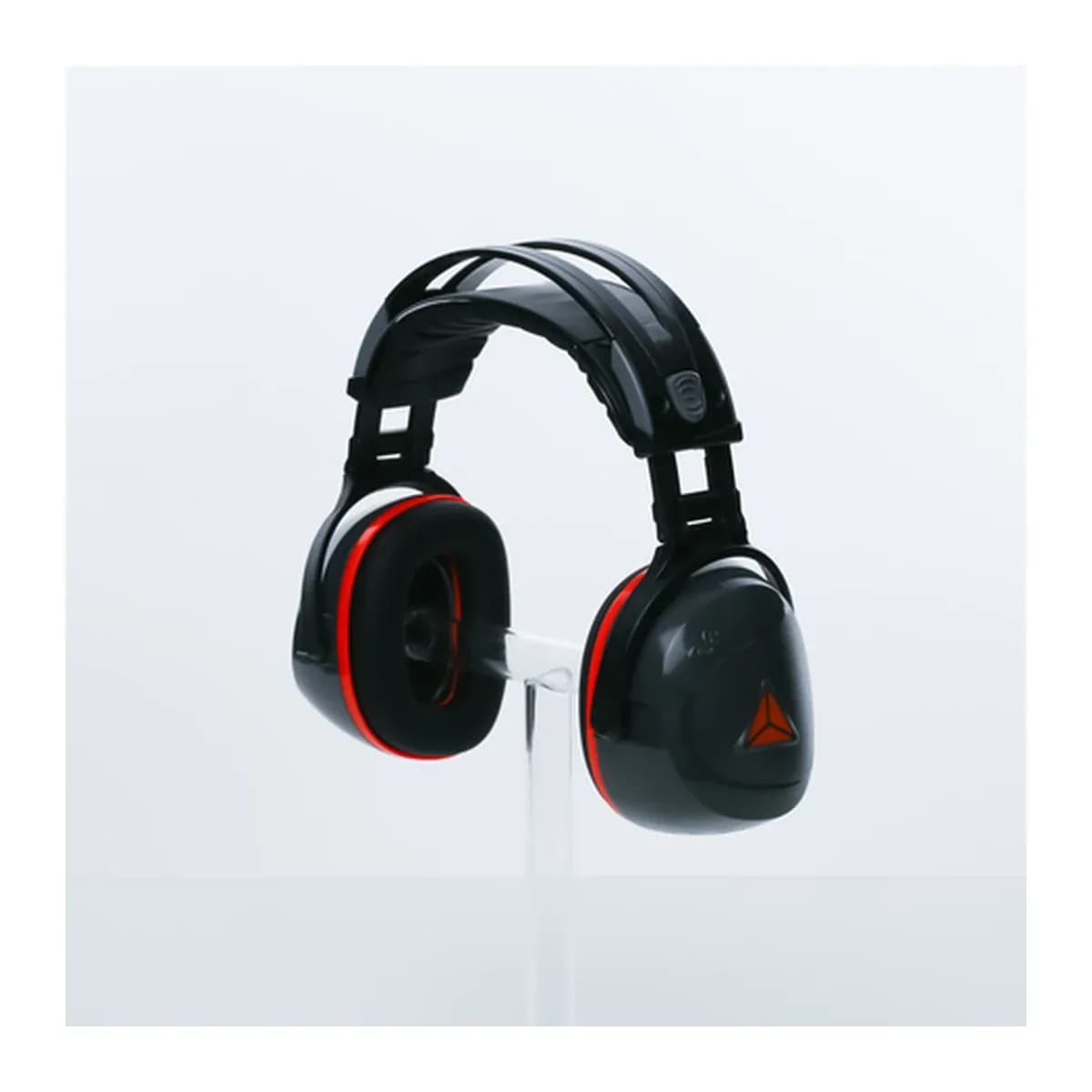
The SNR value on earmuffs and earplugs shows how much the sound is reduced on average, and the EN 352 part number shows the type of protector. This guide explains how to read the label, how to estimate the sound reaching the ear and what the legal action values are, with diagrams.
- EN 352-1Earmuffs with headband
- SNR 33Single number rating: 33 dB
- H · M · LSeparate values for high, medium and low frequencies; in the user manual
Attenuation is measured to EN ISO 4869-1; SNR and H, M, L are calculated to EN ISO 4869-2. The US NRR uses a different method and is not directly comparable with SNR.
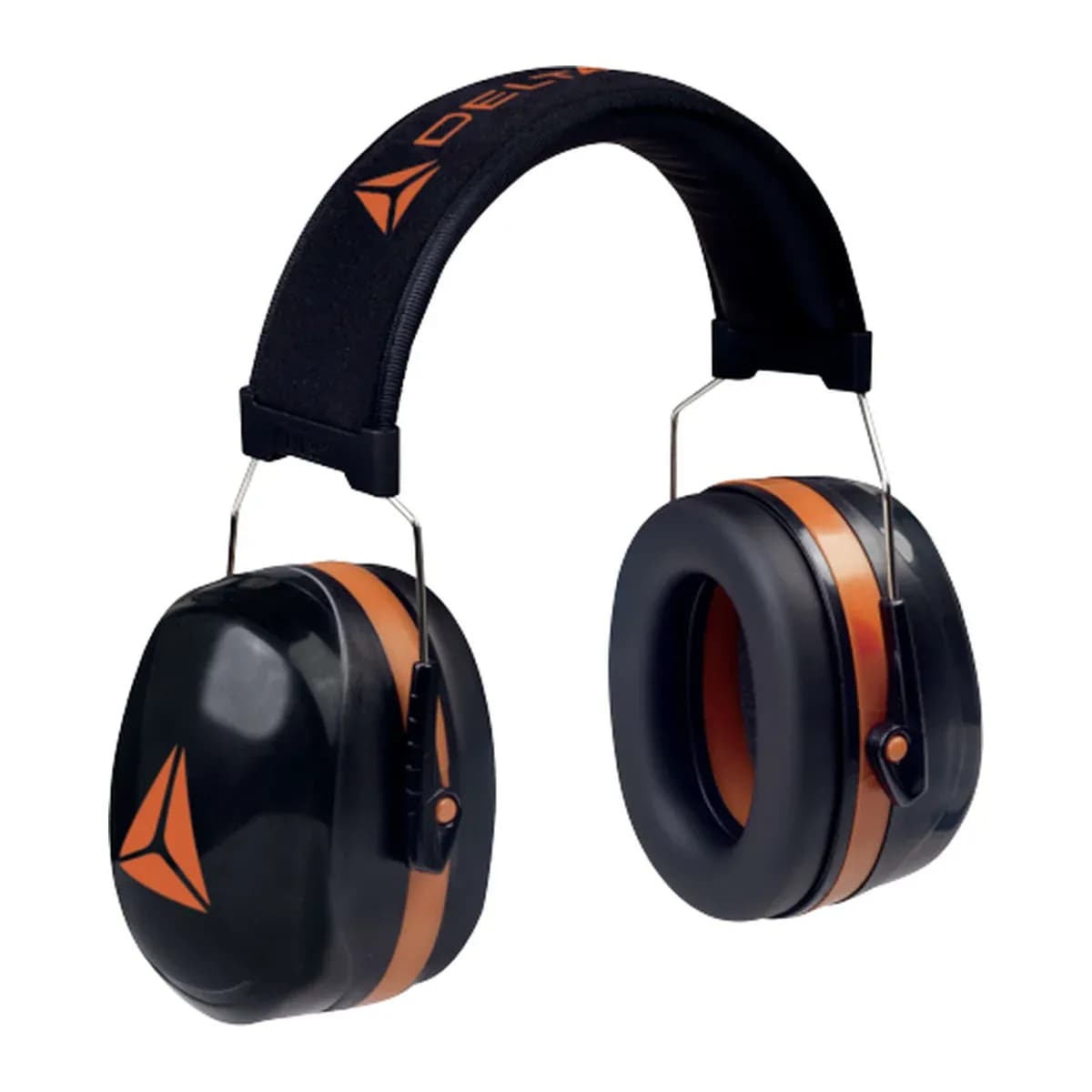 Example productDelta Plus MAGNY COURS 2
- EN 352-1Earmuffs
- EN 352-2Earplugs
- EN 352-3Earmuffs attached to head or face protection
- EN 352-4Level-dependent earmuffs
- EN 352-5Active noise reduction earmuffs
- EN 352-6Earmuffs with safety-related audio input
- EN 352-7Level-dependent earplugs
- EN 352-8Entertainment audio earmuffs
- EN 352-9Earplugs with safety-related audio input
- EN 352-10Entertainment audio earplugs
Current editions: 2020 for -1, -3, -4, -5 and -7; 2020+A1:2024 for -2, -6, -8, -9 and -10.
Example: a workplace measured at 98 dB(C). Estimated level at the ear = workplace level − SNR, plus the 4 dB HSE suggests for real-world use.
- 176 dB(A)SNR 26 dB earmuff: 98 − 26 + 4
- 269 dB(A)SNR 33 dB earmuff: 98 − 33 + 4
- 365 dB(A)SNR 37 dB earplug: 98 − 37 + 4
A level of 70–80 dB(A) is the common good-practice target (EN 458). HSE advises against going below 70 dB at the ear: warning signals and speech may be missed. This is only an example; select on real measurements and H, M, L values.
In Türkiye: the Noise Regulation (Official Gazette 28.07.2013, 28721), Article 5, in line with EU Directive 2003/10/EC. Values are 8-hour daily exposure and peak sound pressure.
- 80 · 135Lower action value, dB(A) · dB(C) peak: hearing protectors are made available
- 85 · 137Upper action value: hearing protectors must be worn and noise reduction measures are taken
- 87 · 140Exposure limit: must not be exceeded, taking the protector into account
The protector’s attenuation counts only when checking the limit value; action values are assessed without it.
The aim when choosing hearing protection is not to cut out as much sound as possible, but to bring the sound reaching the ear into a safe range. Too much protection makes warning signals and speech harder to hear and can lead workers to take the protector off.
How to read the diagrams
- Label: EN 352-1 stands for earmuffs with a headband, and SNR 33 means the sound is reduced by 33 dB on average. Separate attenuation values for high, medium and low frequencies (H, M, L) are given in the instructions for use.
- EN 352 parts: each part of the standard covers one type of protector: earmuffs, earplugs, helmet-mounted earmuffs, level-dependent and active noise reduction models, and models with audio input.
- Sound at the ear: in the example, in an environment measured at 98 dB C-weighted, the SNR is subtracted from the ambient level and 4 dB is added for real-world losses, as HSE recommends. The SNR 26 dB earmuff stays in the target range, while protectors with SNR 33 and 37 dB drop below 70 dB(A) in this environment.
- Legal action values: above 80 dB(A), hearing protectors are made available to workers; at 85 dB(A), wearing them is mandatory. The 87 dB(A) limit must not be exceeded even when the effect of the protector is taken into account.
Short selection checklist
- Have the noise in the work area measured, so you know the daily exposure and the peak value.
- Choose a protector that keeps the sound at the ear at about 70–80 dB(A); do not pick a needlessly high SNR.
- If the noise is concentrated at certain frequencies, calculate with the H, M and L values instead of the SNR.
- If it will be worn with a safety helmet, choose helmet-mounted earmuffs (EN 352-3) and ask the manufacturer for the list of compatible helmets.
- Show workers how to fit earplugs correctly; where earmuffs are worn with spectacles, check the seal.
This guide is for general information. For exact requirements, the current text of the standard, the applicable regulations and the product's instructions for use apply.
Frequently asked questions
Is an earmuff with a higher SNR always better?
No. If the sound at the ear drops below 70 dB(A), warning signals and speech may become inaudible; this is why HSE advises avoiding overprotection. The target is roughly 70–80 dB(A) at the ear.
What do the 80 and 85 dB(A) values mean?
Under Directive 2003/10/EC and the Turkish noise regulation based on it, 80 dB(A) is the lower action value: above it, hearing protectors are made available to workers. 85 dB(A) is the upper action value: at this level wearing hearing protection is mandatory. 87 dB(A) is the limit that must not be exceeded even with the protector worn.
Are NRR and SNR the same thing?
No. NRR is a value used in the United States and calculated by a different method. Protectors certified to EN 352 are given an SNR and H, M and L values calculated to EN ISO 4869-2; the two values cannot be compared directly.
Sources
- EU-OSHA – Directive 2003/10/EC (noise)
- Resmî Gazete – Çalışanların Gürültü ile İlgili Risklerden Korunmalarına Dair Yönetmelik (28721) · 2013-07-28
- HSE – Hearing protection in the real world
- HSE – Avoiding overprotection
- HSE – Hearing protection
- EVS (Estonian Centre for Standardisation) – EVS-EN 352-2:2020+A1:2024
- EVS (Estonian Centre for Standardisation) – EVS-EN 352-3:2020
- EVS (Estonian Centre for Standardisation) – ISO 4869-2:2018
This article is compiled from these sources; for technical values and obligations, the current edition of the source applies.