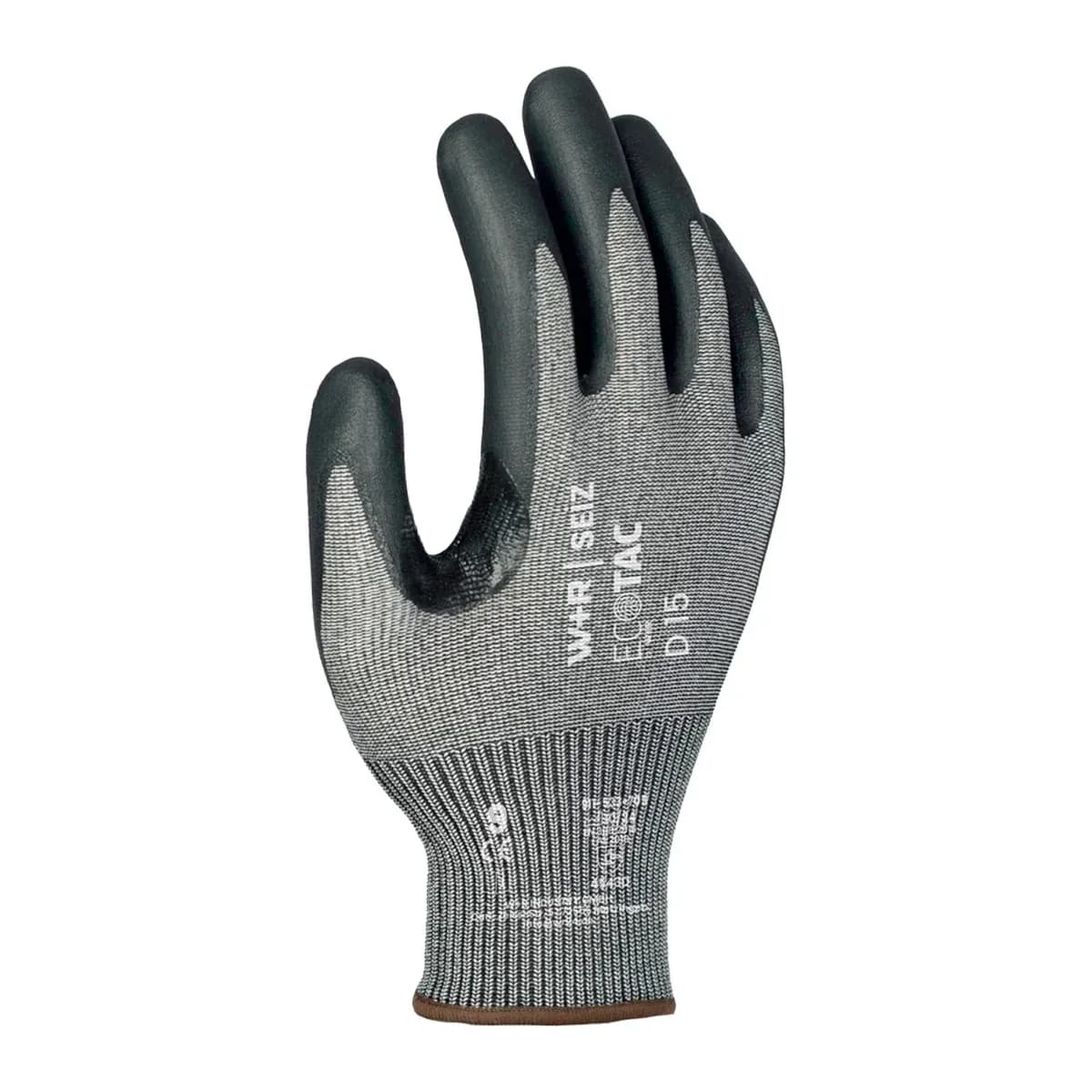
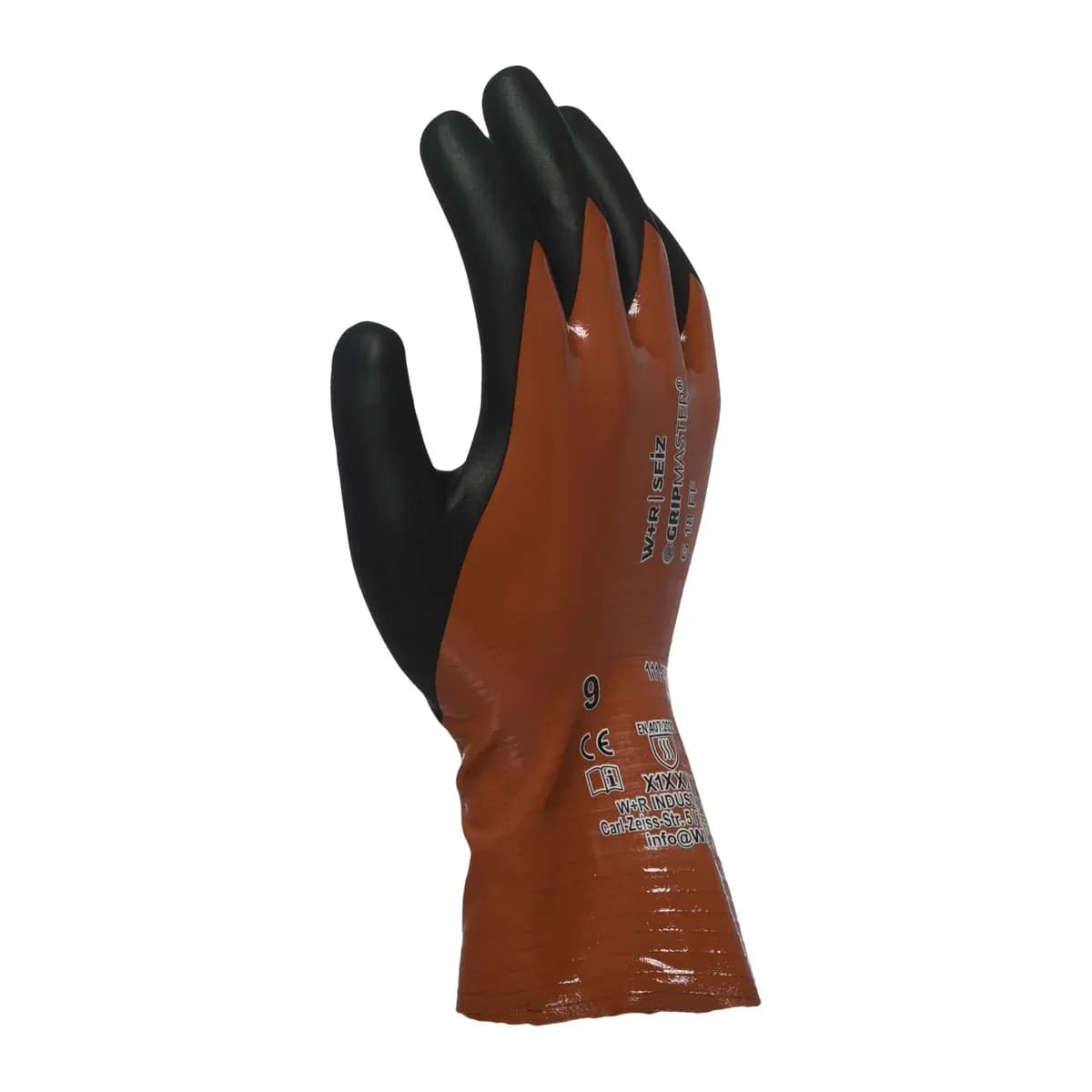
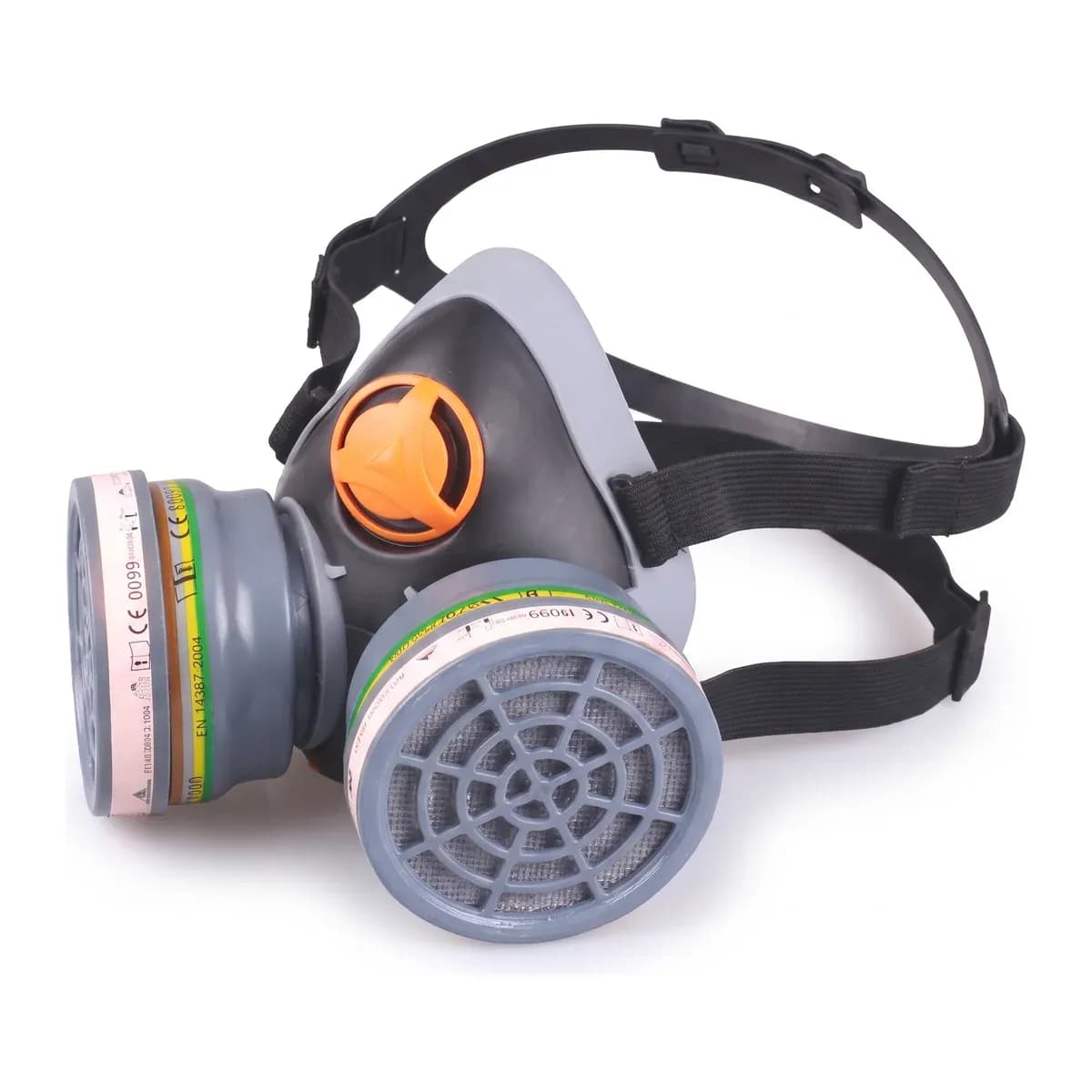
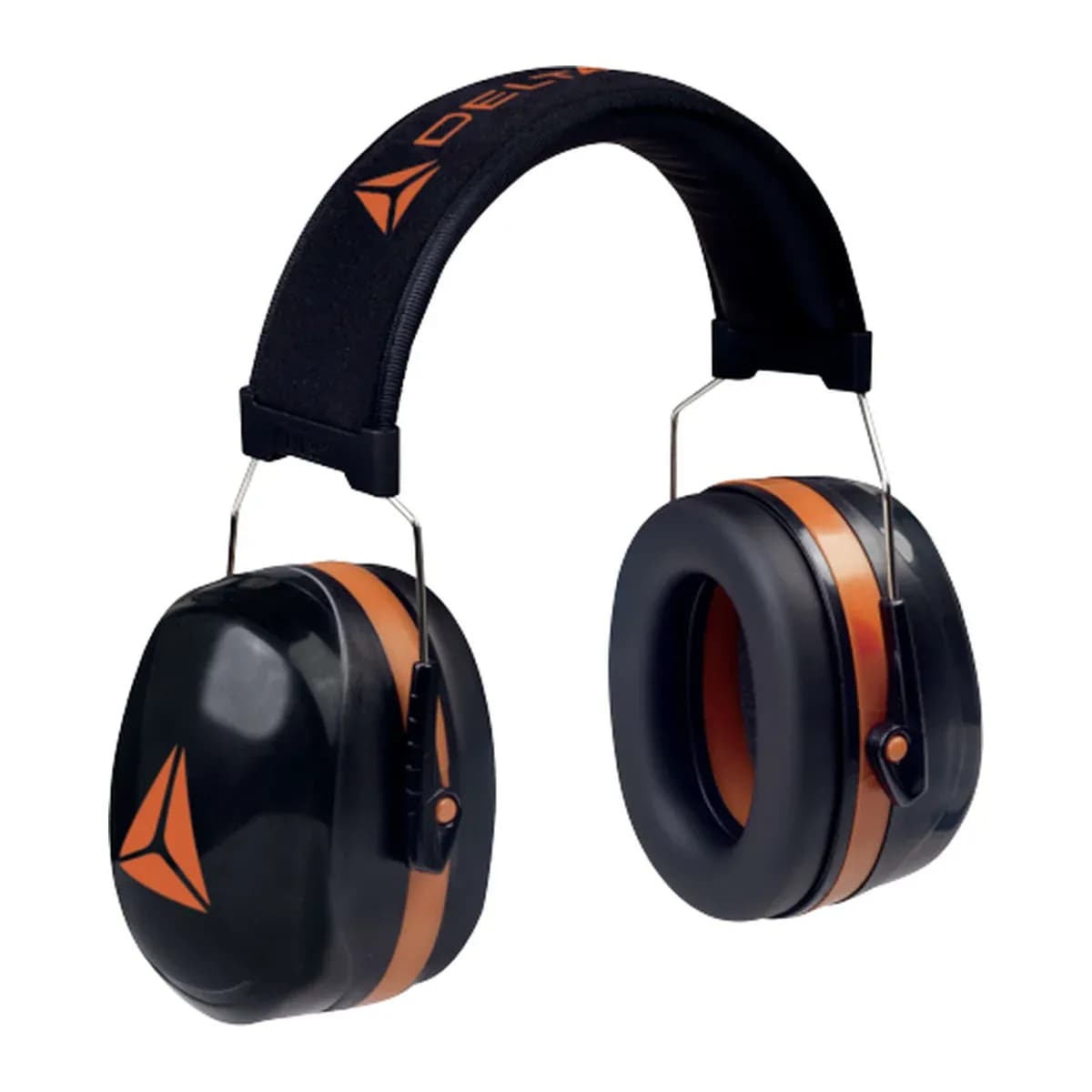
Codes such as 4544C on a glove give its resistance to abrasion, cuts, tearing and puncture, in that order. This guide explains the EN 388 levels and the standards for chemical, heat, cold, welding and electrical gloves with diagrams.
The four digits and one or two letters under the EN 388 hammer pictogram are the levels reached in the mechanical tests.
- 4Abrasion (1–4)
- 5Cut, rotating blade (1–5)
- 4Tear (1–4)
- 4Puncture (1–4)
- CCut, TDM test (A–F)
X: not tested or not applicable. A sixth character P means the glove passed the impact test to EN 13594.
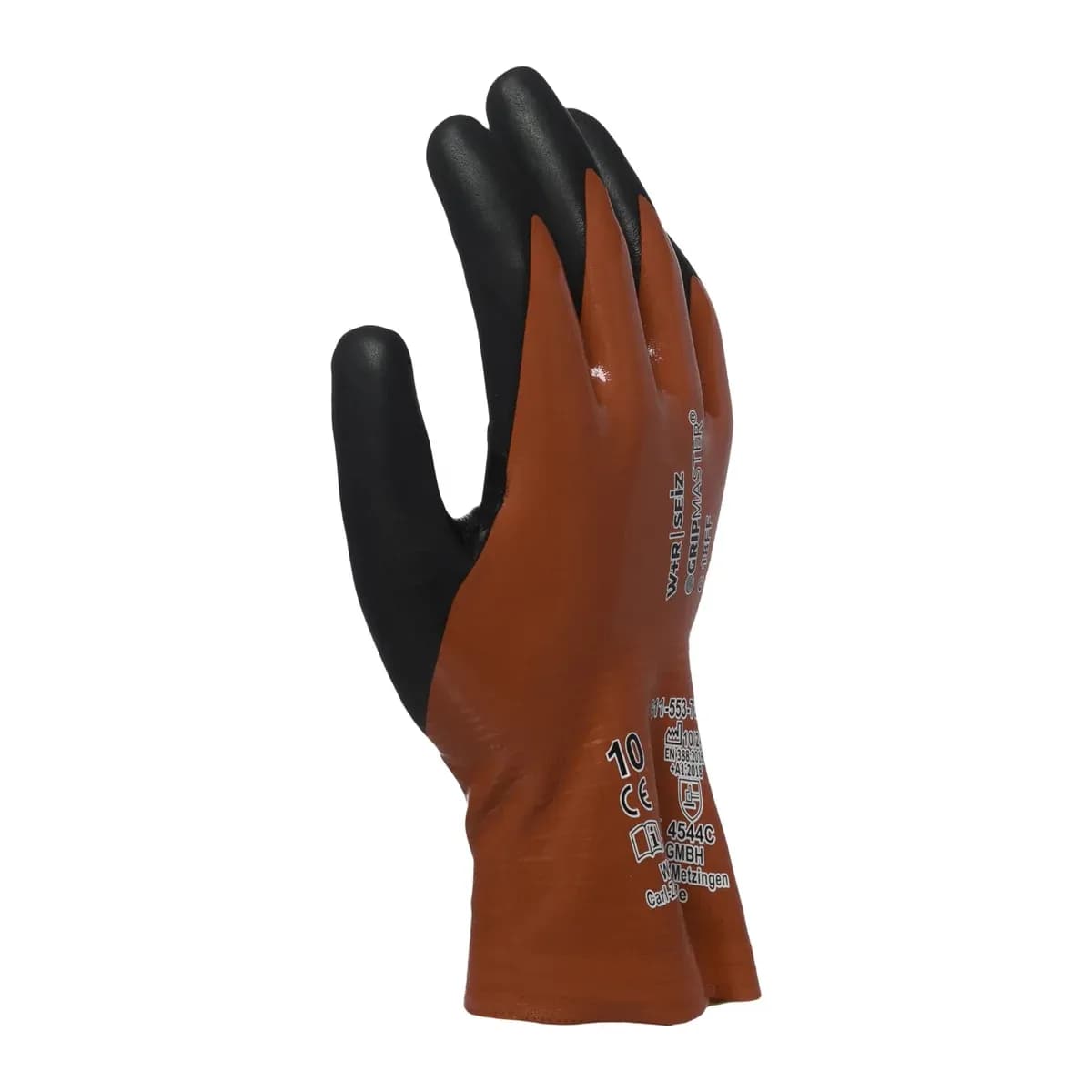 Example productW+R GRIPMASTER C18 FF
The minimum value for each level. The blue box is the example glove’s level.
EN 388 · 4544C
- 1100
- 2500
- 32,000
- 48,000
- 11.2
- 22.5
- 35.0
- 410.0
- 520.0
- 110
- 225
- 350
- 475
- 120
- 260
- 3100
- 4150
- A2
- B5
- C10
- D15
- E22
- F30
Cut-resistant materials can blunt the coupe blade; the TDM result is then the reference and the coupe level may read X.
- EN ISO 21420General requirements: sizing, dexterity, innocuousness. Replaced EN 420
- EN 388Mechanical risks
- EN ISO 374-1Dangerous chemicals
- EN ISO 374-5Micro-organisms; the VIRUS marking needs ISO 16604 method B
- EN 407Heat and flame
- EN 511Cold
- EN 12477Welders’ gloves: Type A higher protection, Type B higher dexterity (TIG)
- EN 60903Electrical insulating gloves
Under EN ISO 21420: the thinnest pin that can be picked up with the gloved hand. Thinner pin, higher level.
Six performances are listed under the flame pictogram, in this order. Example glove: X 1 X X X X (contact heat only, level 1).
- 1Limited flame spread
- 2Contact heat
- 3Convective heat
- 4Radiant heat
- 5Small splashes of molten metal
- 6Large quantities of molten metal
Since 2020 a heat-only pictogram is used when flame spread is not tested; the flame pictogram needs at least level 1 for flame spread.
At this surface temperature the inside of the glove stays below the limit for at least 15 seconds.
In EN ISO 374-1 the type depends on how many chemicals from the list below the glove withstands, and for how long. The tested letters appear under the pictogram.
- AType A: at least 6 chemicals, each ≥ 30 min
- BType B: at least 3 chemicals, each ≥ 30 min
- CType C: at least 1 chemical, ≥ 10 min
- AMethanol
- BAcetone
- CAcetonitrile
- DDichloromethane
- ECarbon disulphide
- FToluene
- GDiethylamine
- HTetrahydrofuran
- IEthyl acetate
- Jn-Heptane
- KSodium hydroxide 40%
- LSulphuric acid 96%
- MNitric acid 65%
- NAcetic acid 99%
- OAmmonium hydroxide 25%
- PHydrogen peroxide 30%
- SHydrofluoric acid 40%
- TFormaldehyde 37%
Under EN 60903 the class gives the maximum AC working voltage of the glove.
DC limits: 750 · 1,500 · 11,250 · 25,500 · 39,750 · 54,000 V.
Each pictogram on a glove stands for a standard, and the digits and letters below it are the test results under that standard. All protective gloves first meet the general requirements of EN ISO 21420; they are then tested against mechanical, chemical, heat, cold or electrical standards depending on the risk. Because each standard has its own scale, levels cannot be compared across standards.
How to read the diagrams
- EN 388 code: the first four digits are the levels for abrasion, rotary-blade cut, tear and puncture. The letter that follows gives the cut level from the TDM test (A–F). X means the test was not carried out or does not apply, and a P as the sixth character shows that the impact test was passed.
- Level thresholds: each level has a lower limit. The example glove passed 8,000 cycles in the abrasion test and the 10 N threshold in the TDM test. For materials that can blunt the rotary blade, the TDM result governs.
- Glove standards: there are separate standards for chemicals (EN ISO 374-1), micro-organisms (EN ISO 374-5), heat and flame (EN 407), cold (EN 511), welding (EN 12477) and electrical work (EN 60903).
- Dexterity: under EN ISO 21420, the thinnest rod that can be picked up with the gloved hand sets the level. Level 5 corresponds to the thinnest rod (5 mm).
- EN 407: the six digits below the flame pictogram are, in order, for flame spread, contact heat, convective heat, radiant heat and two kinds of molten metal splash. For contact heat, level 4 corresponds to a 500 °C surface.
- Chemical gloves: Type A, B and C show how many chemicals from the list the glove resists and for how long. The letters below the pictogram are the chemicals tested.
- Electrical gloves: the EN 60903 class shows the highest voltage the glove can be used at: 500 V for class 00 and 36,000 V AC for class 4.
Short selection checklist
- List the risks to the hands: sharp edges, abrasion, puncture, chemicals, heat, cold and electricity.
- When handling sharp parts, check the TDM letter in the EN 388 code and set the required level according to the task.
- For chemical work, compare the letters tested with the chemicals you use; if your chemical is not on the list, ask the manufacturer for test data.
- For fine assembly work, pay attention to the dexterity level and the glove size.
- Use electrical gloves only at the voltage their class allows and inspect them for damage before every use.
This guide is for general information. For exact requirements and test methods, the current text of the standard and the product's instructions for use apply.
Frequently asked questions
What does the C in 4544C mean?
C is the level from the TDM cut test in EN 388 and shows that the glove withstood at least 10 N in this test. The TDM scale runs from A (2 N) to F (30 N).
What does X mean in an EN 388 code?
X shows that the test was not carried out or could not be applied because of the glove's construction. Highly cut-resistant materials can blunt the rotary blade, so for these gloves the TDM result governs and the rotary-blade level may be given as X.
What are Type A, B and C on chemical gloves?
Under EN ISO 374-1, Type A resists at least 6 chemicals from the list for at least 30 minutes each; Type B at least 3 chemicals for 30 minutes; Type C at least 1 chemical for 10 minutes. The type does not mean the glove resists every chemical; check whether the chemical you use was tested.
Sources
This article is compiled from these sources; for technical values and obligations, the current edition of the source applies.