From 1 January 2026, SOLAS II-2/10.11 prohibits the use and storage on board of fire-extinguishing media containing PFOS. MSC.1/Circ.1694 explains the threshold value and the documentation expected.
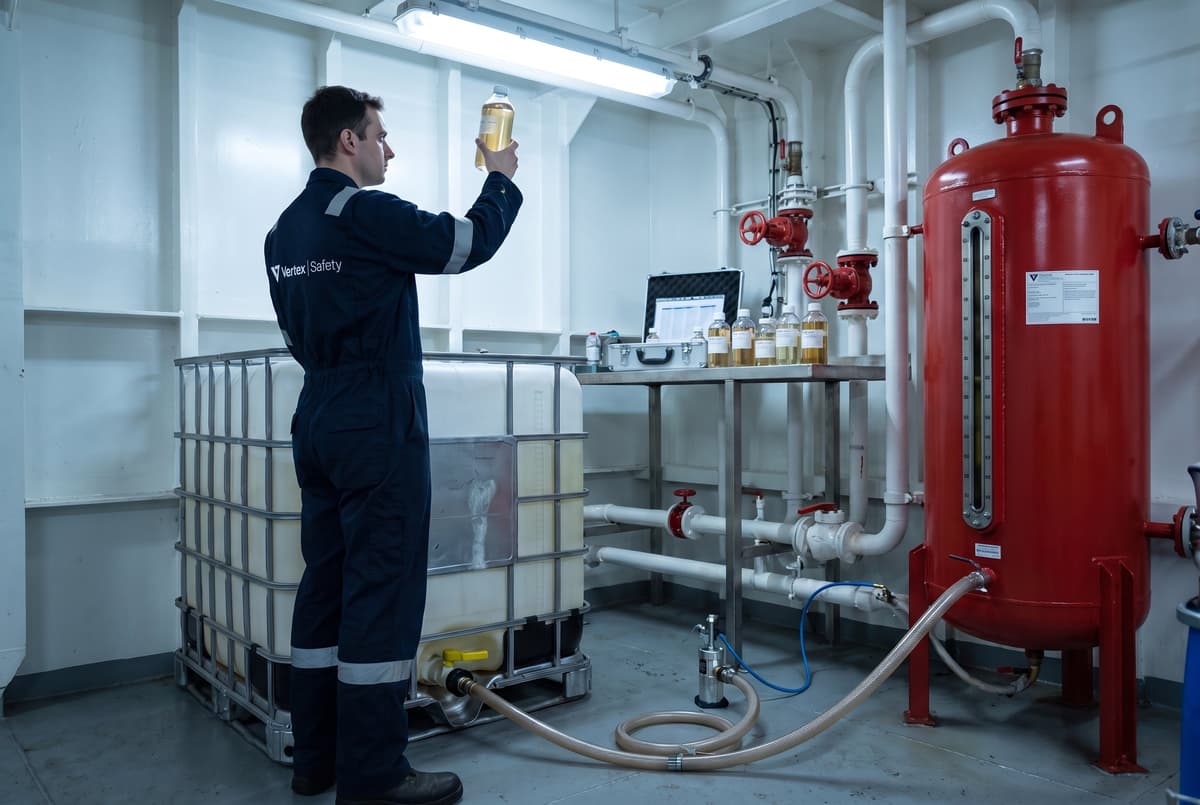
Regulation 10.11, added to SOLAS Chapter II-2 by IMO resolution MSC.532(107), entered into force on 1 January 2026. The regulation prohibits the use and storage on board of fire-extinguishing media containing PFOS (perfluorooctane sulfonic acid). For new ships, application depends on the construction date; for existing ships, it depends on the first survey after 1 January 2026.
What does the regulation say?
- The aim is to protect those on board from exposure to hazardous substances used in firefighting and to minimise the impact of fire-extinguishing media considered harmful to the environment.
- 10.11.1: The regulation applies to ships constructed on or after 1 January 2026.
- 10.11.2.1: When prohibited media are removed from the ship, they must be delivered to port reception facilities.
- 10.11.2.2: The use and storage of fire-extinguishing media containing PFOS is prohibited.
- II-2/1.2.10: Ships constructed before 1 January 2026 must comply with 10.11.2 no later than the first survey after that date.
How does MSC.1/Circ.1694 clarify implementation?
The unified interpretations in MSC.1/Circ.1694 of 4 July 2025, approved at MSC 110, were issued for Member States to use as guidance when applying SOLAS II-2/1.2.10 and 10.11.2.2 and paragraph 7.9.4 of the HSC Code from 1 January 2026:
- The term "fire-extinguishing media" also covers firefighting foams.
- "Containing PFOS" is interpreted as a PFOS content above 10 mg/kg (0.001 per cent) by weight.
- The Administration or recognised organisation reviews the manufacturer's declaration or laboratory test report provided by the shipyard, repair facility or equipment manufacturer.
- The manufacturer's declaration should state the foam type, production period, batch number and a reference to the type approval or MED certificate.
- For media placed on board before 1 January 2026 for which there is no declaration or test report, on-board sampling and testing according to a recognised standard is envisaged.
Practical checklist for technical managers
- Draw up an inventory of the concentrates in fixed foam systems and portable foam units.
- Check whether a manufacturer's declaration or test report is available for each batch; if not, plan sampling and testing.
- If replacement is required, plan in advance the delivery of the old concentrate to a port reception facility and its documentation.
- When procuring new foam, make sure the declaration contains the information listed in Circ.1694.
- Keep track of your first survey date; for existing ships, the deadline depends on this survey.
The interpretations in Circ.1694 are also used as the basis when applying paragraph 7.9.4 of the HSC Code to high-speed craft. This summary is not legal advice; you should check the current text and implementation instructions of your flag State, classification society and inspection body.
For foam analysis, emptying and refilling, you can visit our PFOS-free foam conversion service and our fixed fire-extinguishing systems page.
Frequently asked questions
When is a foam considered to be "containing PFOS"?
According to MSC.1/Circ.1694, when its PFOS content exceeds 10 mg/kg (0.001 per cent) by weight.
When must existing ships comply with the PFOS ban?
Under SOLAS II-2/1.2.10, ships constructed before 1 January 2026 must comply with 10.11.2 no later than the first survey after 1 January 2026.
Sources
- IMO – Resolution MSC.532(107): SOLAS değişiklikleri (II-2/1.2.10 ve 10.11) · 2023-06-08
- IMO MSC.1/Circ.1694 – SOLAS II-2/1.2.10, 10.11.2.2 ve HSC 7.9.4 birleşik yorumları (Norveç Denizcilik İdaresi kopyası) · 2025-07-04
This article is compiled from these sources; for technical values and obligations, the current edition of the source applies.